Breathing
Breathing exercises for anxiety
There are dozens of breathing techniques and they mostly do the same thing by different routes. Here's the rule underneath all of them, six patterns worth knowing, and which one to reach for in which situation.
The short answer
Every breathing technique that reduces anxiety works through the same mechanism: a longer exhale than inhale. Heart rate rises as you breathe in and falls as you breathe out, so weighting the out-breath slows you down. If you're spiking, use the physiological sigh — two inhales, one long exhale. If you want steady calm over several minutes, use box breathing or 4-7-8. If you remember nothing else, just make the out-breath longer.
The one rule underneath all of them
Your heart rate isn't constant. It rises slightly as you inhale and falls as you exhale — a normal, healthy pattern. Every effective breathing technique exploits it the same way: spend more time exhaling than inhaling, and your average heart rate comes down.
That's why the specific counts matter far less than people think. A 4-in/6-out is not meaningfully different from a 3-in/5-out. What matters is the ratio and the slowness. Somewhere around five to six breaths a minute is where most of the research clusters.
If you remember one thing
Longer out than in. That single instruction is most of the benefit of every technique below.
1. The physiological sigh — fastest for a spike
Two inhales through the nose (a full one, then a short sharp top-up), then one long, slow exhale through the mouth. One to three rounds.
This is the one to use when something has just happened and you're climbing. The double inhale reinflates collapsed air sacs in the lungs, which makes the following exhale more efficient at offloading carbon dioxide. There's controlled-trial evidence that a few minutes a day of this outperforms equivalent time in ordinary mindfulness for mood and arousal. Full detail in the physiological sigh.
2. Box breathing — best for sustained steadiness
In for 4, hold for 4, out for 4, hold empty for 4. Repeat for two to five minutes.
The even rhythm and the countable structure make this the easiest one to hold onto when your mind is racing — there's always a next number. It's the standard choice before a high-pressure moment rather than during a crisis. See box breathing.
3. 4-7-8 breathing — for winding down
In through the nose for 4, hold for 7, out through the mouth for 8. Four cycles is plenty to start.
The long hold and very long exhale make this a strong down-regulator, which is why it's most often recommended before sleep. It's also the most likely of these to feel uncomfortable at first — if 7 and 8 are a strain, scale the whole thing down and keep the proportions (2-3.5-4 works fine). Don't do this one standing up the first few times.
4. Simple extended exhale — when counting is too much
Breathe in normally. Breathe out for about twice as long. No holds, no fixed numbers.
Sometimes counting itself becomes another thing to fail at. This version keeps the only part that matters and drops everything else. It's also the most discreet — nobody in the meeting can tell.
5. Diaphragmatic (belly) breathing — for the shallow-breather default
One hand on your chest, one on your belly. Breathe so the lower hand moves and the upper one mostly doesn't. Slow, into the belly, out slowly.
Anxious breathing tends to migrate up into the chest and get shallow. This retrains the default. It's less of an emergency tool and more of a five-minutes-a-day practice, and it makes the others easier.
6. Pursed-lip breathing — when you feel like you can't get enough air
In through the nose for 2. Out through pursed lips — as if blowing out a candle slowly — for 4.
The air-hunger feeling during panic is usually the result of over-breathing, not under-breathing; you have plenty of oxygen and too little carbon dioxide. The resistance of pursed lips slows the exhale and helps rebalance that, which is why it eases the sensation of not being able to breathe. Relevant during a panic attack.
Which one, when
- Something just happened, I'm climbing: physiological sigh.
- I have a hard thing in ten minutes: box breathing.
- I can't switch off at bedtime: 4-7-8, or see anxiety at night.
- I can't get enough air: pursed-lip.
- I'm in public and can't be obvious: extended exhale.
- I want this to be less necessary over time: diaphragmatic, daily.
If breathing exercises make you more anxious
This happens to a meaningful minority of people, and it isn't a failure. Paying close attention to your breathing can itself become threatening, particularly if your anxiety centres on physical sensations, and holds can be genuinely unpleasant.
If that's you: drop all holds, keep the exhale extension only, keep your eyes open, and consider starting with something that isn't interoceptive at all — external grounding is a better entry point. Other options are in coping skills for anxiety.
Tools for this in the app
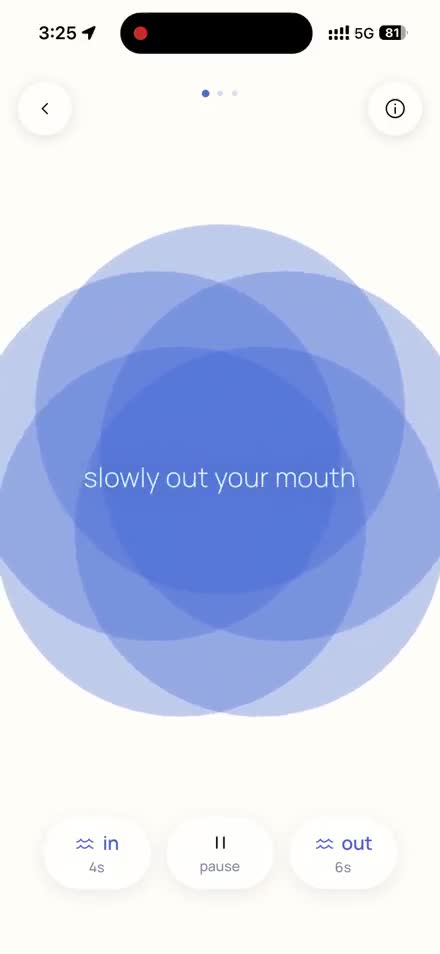
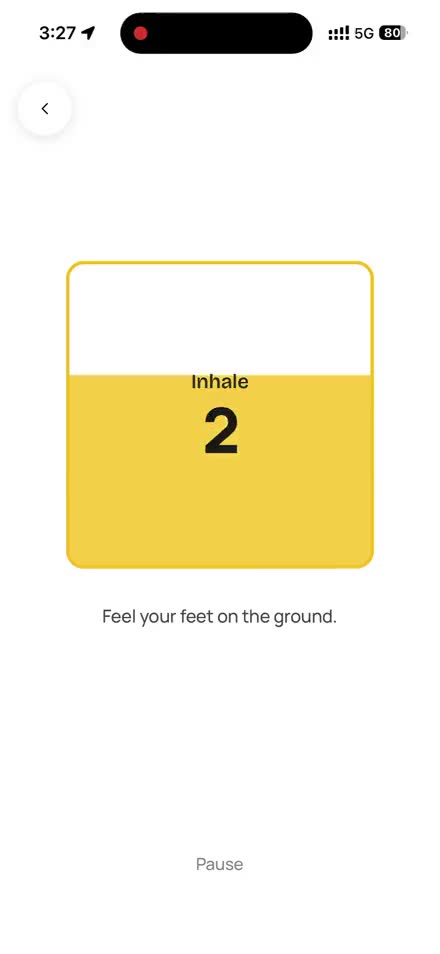
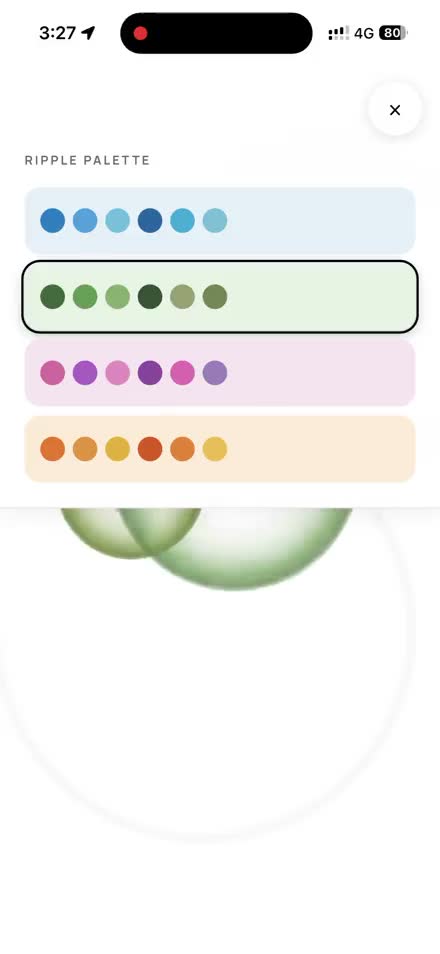
Paced for you, so you don't count.
centered space paces each pattern visually — follow the shape, and the timing takes care of itself.


Common questions
What is the best breathing exercise for anxiety?
It depends on the moment. For a sudden spike, the physiological sigh — two inhales through the nose and one long exhale — works fastest. For sustained calm before a stressful event, box breathing is easier to hold onto. For winding down at night, 4-7-8. All of them work through the same mechanism: an exhale longer than the inhale.
Why does a longer exhale calm you down?
Your heart rate naturally rises slightly as you inhale and falls as you exhale. Spending more time in the exhale phase means more time with your heart rate falling, which lowers your average rate and signals to your body that there's no emergency. This is the mechanism behind essentially every effective breathing technique.
How long do I need to do a breathing exercise for?
One to three rounds of the physiological sigh can shift an acute spike in under a minute. For steadier patterns like box breathing, two to five minutes is typical. Research on slow breathing generally finds effects at around five to six breaths per minute sustained for a few minutes.
Can breathing exercises make anxiety worse?
For some people, yes. Focusing closely on your breathing can itself feel threatening, especially if your anxiety centres on physical sensations, and breath holds can be uncomfortable. If that happens, drop the holds, keep only the extended exhale, keep your eyes open, or start with external grounding instead of anything breath-focused.
Not medical advice. These are general wellness techniques, not treatment for a medical or psychiatric condition. If anxiety, low mood, or intrusive thoughts are affecting your daily life, talk to a doctor or a licensed therapist. If you're in crisis, contact your local emergency number or a crisis line.
Sources
- Balban, M. Y. et al. (2023). Brief structured respiration practices enhance mood and reduce physiological arousal. Cell Reports Medicine.
- Zaccaro, A. et al. (2018). How breath-control can change your life: a systematic review on slow breathing. Frontiers in Human Neuroscience.
- Cleveland Clinic: diaphragmatic breathing and pursed-lip breathing technique guidance.