Body & breath
How to regulate your nervous system
The phrase is everywhere now, usually attached to something being sold. Underneath the packaging there's something genuinely useful — and a few claims that have run well ahead of the evidence. Both are worth knowing.
The short answer
Your autonomic nervous system has two branches: a sympathetic one that mobilises you (faster heart, tense muscles, alert) and a parasympathetic one that settles you. "Regulation" just means being able to shift between them appropriately rather than getting stuck in one. The most reliable in-the-moment lever is your breath — specifically making your exhale longer than your inhale, which slows heart rate. Cold, movement, and safe human contact also shift state. Most of the rest is packaging.
What the words actually mean
Your autonomic nervous system runs the things you don't consciously control — heart rate, digestion, breathing, pupil size. It has two branches that work like a balance:
- Sympathetic. The mobiliser. Heart rate up, muscles ready, attention narrowed, digestion parked. Useful and necessary — this is what gets you through a deadline or out of the road.
- Parasympathetic. The settler. Heart rate down, muscles loosening, digestion back online. Sometimes called "rest and digest."
Neither is good or bad. A well-regulated nervous system isn't one that's permanently calm — it's one that mobilises when there's something to meet and comes back down afterwards. The problem people describe as dysregulation is usually getting stuck: either mobilised long after the event ended, or flattened and unable to mobilise at all.
The one lever that reliably works
Your breath is the only part of this system you can operate directly, and it's a genuine control surface rather than a metaphor. Heart rate rises slightly as you breathe in and falls as you breathe out. So a breath pattern where the exhale is longer than the inhale spends more time in the falling phase, and your heart rate follows.
That's the mechanism behind almost every breathing technique that works:
- For a spike, right now: the physiological sigh — two inhales through the nose, one long slow exhale through the mouth. There's decent controlled-trial evidence that a few minutes of this beats equivalent time spent in ordinary mindfulness for immediate mood and physiological arousal.
- For sustained steadiness: box breathing, or any slow, even pattern at roughly five to six breaths per minute.
- The general rule: if you remember nothing else, make the out-breath longer than the in-breath. That single instruction covers most of it.
More options are collected in breathing exercises for anxiety.
What else genuinely shifts state
- Cold on the face. Cold water on the face, especially around the eyes and cheekbones, triggers a reflex that slows heart rate. It's abrupt and it's effective — one of the few things that reliably works at very high intensity.
- Movement. If your body has mobilised energy, giving it an outlet completes the loop rather than leaving it circulating. Brisk walking, stairs, or shaking out your limbs all count.
- Long, slow exhales you don't have to think about. Humming, singing, sighing — all of these lengthen the out-breath as a side effect.
- Other people. Calm, safe human contact is one of the strongest regulators there is, which is why isolation makes everything harder. See reconnecting with people.
- Orienting. Slowly turning your head and letting your eyes land on the actual room — the basis of grounding techniques — tells a scanning system there's nothing here to find.
- Sleep and food. Unglamorous and enormous. An under-slept, under-fed nervous system is a reactive one, and no breathing technique compensates for a week of four-hour nights.
Where to be sceptical
This is worth saying plainly, because the topic attracts a lot of confident overclaiming.
Polyvagal theory — the model most "nervous system regulation" content is implicitly built on — is a proposed framework, and several of its specific anatomical claims are actively disputed by researchers in the field. That doesn't mean the practices are useless; slow breathing and safe social contact do measurably change physiology regardless of which model explains them. But treat confident anatomical explanations, and anything sold on the strength of them, with some caution.
"Vagus nerve hacks" — ice baths, ear massage, gargling, various devices — range from reasonable to entirely unevidenced. The reasonable ones mostly work through the same route as everything above: a slower exhale or a cold stimulus.
Beware "your body is stuck in freeze." It's an appealing story and it's not diagnostic. Persistent numbness, dissociation, or feeling permanently switched-off deserves a professional, not a breathing exercise — see grounding for dissociation for the in-the-moment piece.
Building the baseline
Everything above is acute — for the moment you're already activated. What actually changes your resting state is duller and slower: regular sleep, regular food, regular movement, some daylight, and a short practice done more days than not.
The practical test of whether it's working isn't whether you feel calm. It's whether you come back down faster than you used to.
Tools for this in the app
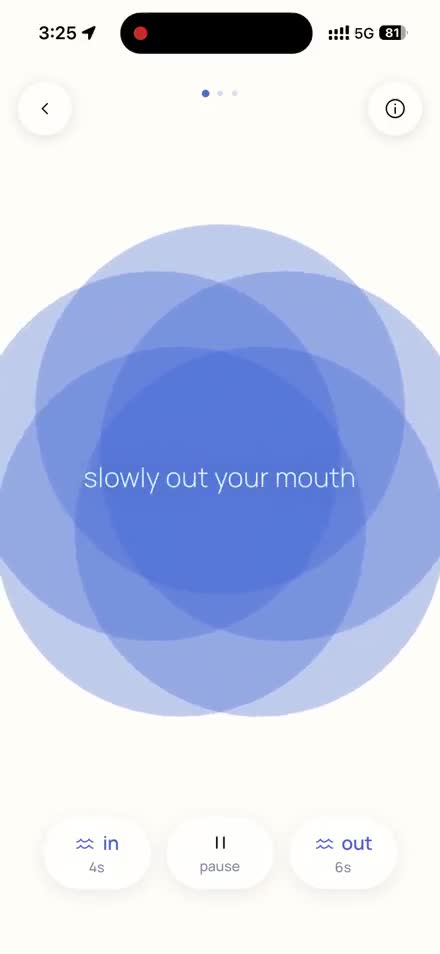
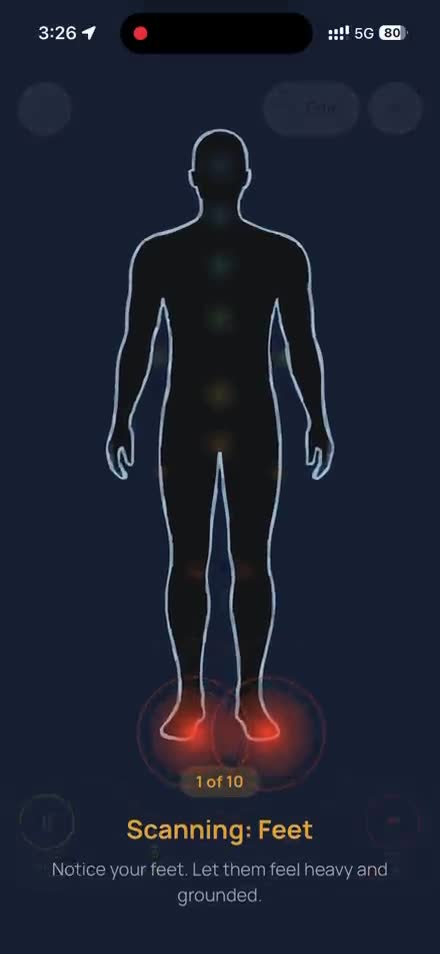
The lever, guided.
centered space paces the breath patterns visually, so the one thing that reliably works is the one thing you don't have to count.


Common questions
What does regulating your nervous system actually mean?
It means being able to shift appropriately between the two branches of your autonomic nervous system — the sympathetic branch that mobilises you and the parasympathetic branch that settles you. A well-regulated system isn't permanently calm; it mobilises when needed and comes back down afterwards. Dysregulation is usually getting stuck in one state.
What is the fastest way to calm your nervous system?
Make your exhale longer than your inhale. Heart rate rises on the in-breath and falls on the out-breath, so a longer exhale directly slows it. The physiological sigh — two inhales through the nose and one long exhale through the mouth — is the quickest version. Cold water on the face is the other reliable fast option.
Do vagus nerve exercises really work?
Some do, though usually not for the reasons claimed. Slow breathing with a long exhale and cold applied to the face have measurable effects on heart rate. Many popular 'vagus hacks' are unevidenced, and polyvagal theory — the model behind most of this content — is a proposed framework whose specific anatomical claims are disputed by researchers.
How long does it take to regulate your nervous system?
In the moment, one to five minutes of slow breathing produces a measurable shift for most people. Changing your baseline is much slower and depends on unglamorous things: sleep, food, movement, daylight, and a short practice done regularly. A good sign of progress is coming back down faster than you used to, not feeling calm all the time.
Not medical advice. These are general wellness techniques, not treatment for a medical or psychiatric condition. If anxiety, low mood, or intrusive thoughts are affecting your daily life, talk to a doctor or a licensed therapist. If you're in crisis, contact your local emergency number or a crisis line.
Sources
- Balban, M. Y. et al. (2023). Brief structured respiration practices enhance mood and reduce physiological arousal. Cell Reports Medicine.
- Zaccaro, A. et al. (2018). How breath-control can change your life: a systematic review on slow breathing. Frontiers in Human Neuroscience.
- Grossman, P. (2023). Fundamental challenges and likely refutations of the five basic premises of the polyvagal theory. Biological Psychology.