Mind & mood
Mirror work: why it's hard to look at yourself
You see your own face every day and almost never look at it. You check it — for what's wrong, what's changed, what needs fixing — and then you move on. Looking is a different thing entirely, and it's surprisingly hard to do.
The short answer
Looking at your own face is uncomfortable because we default to evaluating rather than seeing — scanning for flaws the way we'd never scan a friend. Two practices work against that. One is cognitive reframing: asking yourself a set of direct questions to test the story you're currently telling. The other is a kindness practice: deliberately looking at your own face the way someone who loves you would. They're different tools for different moments.
Checking is not looking
Most encounters with your reflection last under two seconds and have a purpose: is there something in my teeth, does this look alright, have I aged. It's an inspection, and inspections are built to find faults.
So the habit you've built over decades is scanning your own face for problems. Then someone suggests looking at yourself with kindness and it feels absurd, or genuinely uncomfortable, and that discomfort gets read as evidence that something's wrong with you. It isn't. You're just running a routine designed for a different job.
Worth knowing before you try it
The awkwardness is nearly universal, and it fades. Most people find the first thirty seconds the hardest part by a distance.
Mode one: question the story
When you're hooked by a thought, the most useful thing isn't reassurance, it's interrogation. Saying the question out loud to your own face makes it much harder to skim past than thinking it does.
These are the questions worth working through — cognitive reframing, in plain language:
- What am I telling myself right now?
- Is that definitely true?
- What is another way to see this?
- What would I say to a friend who felt this way?
- Is this moment, right now, actually dangerous?
- What do I need right now that I haven't asked for?
- Where am I feeling this in my body?
- What is the worst that could happen — and could I live through it?
- Am I taking this all the way to the worst case?
- Am I letting fear decide for me right now?
Don't work through all ten. Pick the one that makes you flinch slightly and stay with it. That flinch is usually the useful one. This is the same move as redirect, release, reframe, done out loud.
Mode two: look with kindness
Different practice, different purpose. Here you're not analysing anything — you're deliberately looking at your face the way someone who loves you would look at it.
Your eyes, and the colour of them. What they've witnessed and what they've carried. Your skin, its texture, the marks and the lines — your history, written where you can see it. The way your hair falls. Your smile, or even just the thought of one.
The point is that a person who loves you looks at exactly the same face and sees none of what you scan for. Both readings are available. You've just been practising one of them for thirty years. This is self-compassion made literal and visual rather than kept as an idea.
Why out loud, and why your own face
Two things make this different from thinking kind thoughts.
Speaking recruits more of you — your voice, your hearing, your breath. A sentence you say is much harder to slide past than a sentence you think, which is why it can feel exposing even alone in a bathroom.
And your own face is not abstract. "Be kinder to yourself" is easy to agree with and ignore. Looking directly at the person you'd be kinder to closes that gap, and closing it is the entire exercise.
If it feels like too much
Start with thirty seconds. Start with your eyes only rather than your whole face. Start with mode one, which is analytical and feels safer, and come to mode two later. Or do it with your eyes closed and just say the words — most of the benefit survives.
If looking at yourself reliably produces intense distress rather than ordinary awkwardness, don't push through it alone. That's worth raising with a therapist — not because something is wrong with you, but because there's usually something underneath it that's more usefully worked on with support than with repetition.
A note on privacy
In centered space, Mirror turns on your front camera so you can see your face while you sit with the words. Nothing is recorded, saved, or sent anywhere — there's no photo, no video, and no upload. It's a mirror, not a camera.
Tools for this in the app
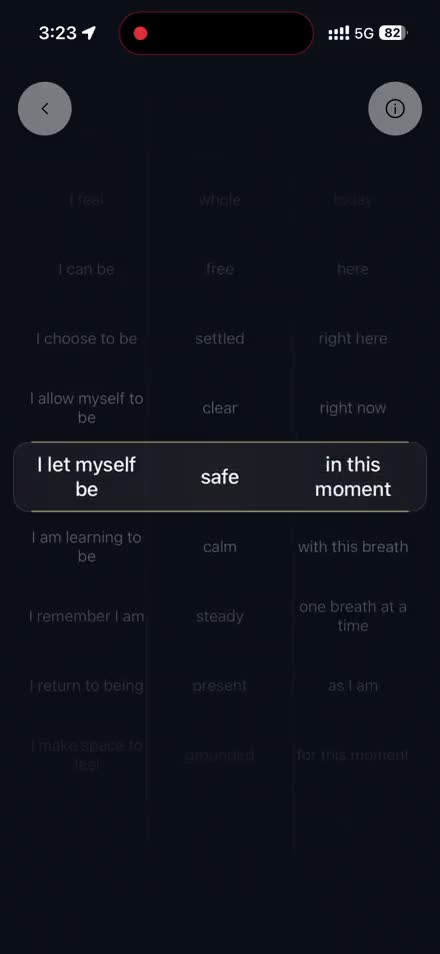
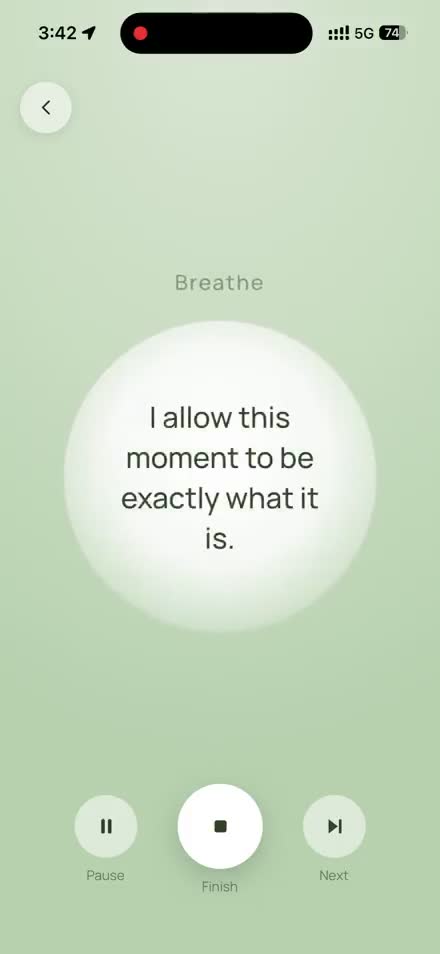

A mirror, and something to say into it.
Mirror has two modes — Redirect cycles the reframing questions, See Yourself guides the kindness practice. Camera on, nothing recorded.


Common questions
What is mirror work?
Using your reflection deliberately rather than glancing at it. In practice it covers two different things: cognitive reframing, where you ask yourself direct questions out loud to test the story you're telling yourself, and a self-kindness practice, where you look at your own face the way someone who loves you would.
Why is it so uncomfortable to look at myself?
Because we're trained to check rather than look. Almost every encounter with your reflection is a brief inspection for what's wrong or changed, so the habit you've built is scanning your own face for faults. Being asked to look kindly runs against decades of that, and the awkwardness is close to universal. It usually fades within the first minute.
Does saying things out loud actually make a difference?
It recruits more of you than thinking does — your voice, your hearing, your breath — and a sentence you say is much harder to skim past than one you think. That's also why it can feel exposing even when you're completely alone, which is a sign it's working rather than a reason to stop.
What if looking at myself makes me feel worse?
Start smaller: thirty seconds, or your eyes only rather than your whole face, or the questioning mode instead of the kindness one. If it reliably produces intense distress rather than ordinary awkwardness, that's worth talking to a therapist about — there's usually something underneath it better worked on with support than with repetition.
Not medical advice. These are general wellness techniques, not treatment for a medical or psychiatric condition. If anxiety, low mood, or intrusive thoughts are affecting your daily life, talk to a doctor or a licensed therapist. If you're in crisis, contact your local emergency number or a crisis line.
Sources
- Beck, J. S. (2011). Cognitive Behavior Therapy: Basics and Beyond — cognitive restructuring and Socratic questioning.
- Neff, K. D. (2003). Self-compassion: an alternative conceptualization of a healthy attitude toward oneself. Self and Identity.
- Gilbert, P. (2009). Introducing compassion-focused therapy. Advances in Psychiatric Treatment.